MonkMaze
Lead Generation & Business Automation Platform
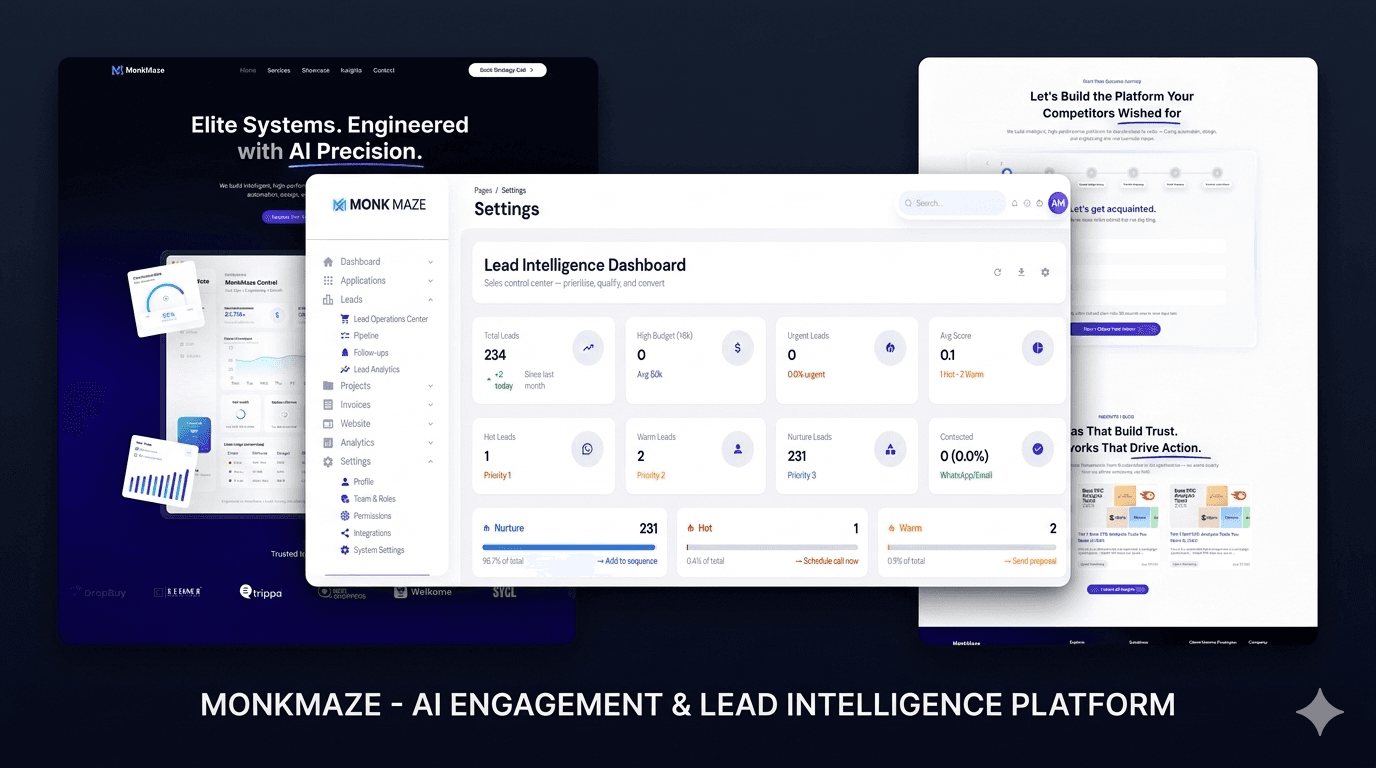
Full-stack lead capture and business automation platform featuring multi-step lead capture, an admin dashboard system, meeting and invoice management, and analytics and blog tools.
01Context & Problem
The client needed a platform to replace fragmented workflows for acquiring and handling leads. The requirements included multi-step lead capture, an admin dashboard system, meeting and invoice management, and analytics and blog tools built with Next.js, Express.js, and MongoDB.
02Engineering Ownership
What I Built
- ▸Built the multi-step lead capture flow and REST APIs using Express.js and Node.js.
- ▸Engineered the admin dashboard system in Next.js and React with role-based access control.
- ▸Implemented backend data models and routes for meeting and invoice management with MongoDB and Mongoose.
- ▸Developed analytics and blog tools within the admin dashboard interface.
What I Did Not Build
- ▸Worked from designs provided by the client rather than producing the visual design myself.
03Stack & Rationale
Provided server rendering and component structure for the admin dashboard system.
Asynchronous REST APIs handling lead capture, meeting, and invoice endpoints.
Document schema modeling for leads, invoices, meetings, and blog content.
Utility-first styling for consistent spacing and layout across the admin interface.
04System Architecture
Component topology, data flows, and authorization boundaries:
05Authentication & Authorization
06Hard Technical Challenges & Solutions
Role Separation Across API Routes
Problem: Standard user accounts and administrators required different levels of access to invoices and meeting management records.
Solution: Role checks were enforced in Express.js middleware rather than in the client UI, ensuring unauthorized requests fail at the API boundary.
Multi-Step Lead Data Validation
Problem: Multi-step lead capture forms submitted data in stages, risking incomplete records reaching the database.
Solution: REST API route handlers validated incoming data payloads at each step before committing records through Mongoose models.
07What I Would Do Differently Now
If I were building this platform today, I would implement automated testing across the REST API routes and add CI/CD with GitHub Actions to run tests on every pull request. I would also containerize the Node.js backend using Docker for consistent development and deployment environments.